



University of Massachusets Athletics
A Superhero's Run: Leveille Caps Exceptional Career
May 27, 2003 | Men's Lacrosse
May 27, 2003
Like a celebrity, Kevin Leveille has to be inconspicuous. While watching a college hockey game at Houston Field House in Troy, N.Y., he slouches in a chair with his face shaded by a maroon baseball cap, hoping to avoid the inevitable - somebody recognizing him.
Delmar, Leveille's hometown, is just a few miles from here. That's where the legend started. Where the rumors of the scrawny kid with the stick attached to his arm traveled through Albany County like a paper bag in a windstorm.
For three periods, he modestly glad-handed those who would bring up the past. He politely listened while some advised him to comeback to the area to play professional lacrosse when he's finished with school.
But now the game demands his attention, as a third period goal by RPI has forced overtime with UMass.
He sits just a few rows behind the visiting goal with his hands tucked comfortably into a denim jacket. Only his eyes are moving as they follow the play.
His body remains still until a UMass defenseman hesitates and coughs up the puck in his own zone. RPI counters quickly and scores, bringing 3,325 people to their feet. Leveille is already headed for the door.
"He can see things before they happen," says teammate and friend Chris Fiore. Statistics will tell you that Leveille is a very skilled lacrosse player. But what sets him apart from the "mortals," as Fiore calls them, is something nobody has been able to explain.
Part of it is the field vision that borders on prescience.
"It's hard to describe, he's a step ahead in his mind," UMass coach Greg Cannella says. "He has the ability to make a play in a fraction of a second. That's the best I can describe it. He might hit a guy in the head with a pass. Then some guys just step back and shake their heads."
There are also the little things he does that would make Yoda bite his little green knuckle in envy.
Like last year against Navy when Leveille was pummeled to the ground on a 1-on-3 fast break. With the Midshipmen hacking at him like Paul Bunyan, he weaved through on his knees and fed a blind pass to a trailing teammate for the goal. Cannella was asked about it after the game and could only reply with "Well, ... Kevin can do that."
In fact, he does it all the time.
In a late March game against Hofstra, Leveille was sandwiched between two Pride defensemen as he entered the restraining box. Somehow, he managed to free his right hand and shovel a pass to Fiore while collapsing to the turf.
"I wish I could help you out," Fiore says. "But I don't know what it is. It's like, when he gets out there he's like Mr. Lacrosse or somethin'.
"Some kind of superhero."
Even Leveille can't explain his so-called "powers." When asked about that play against Navy, he becomes a foil of his on-field self. Instead of smooth and calm, he looks uncomfortable in his own skin.
"I don't know," he says while shifting awkwardly in a metal school chair. "I saw him coming before I got hit I guess. I kind of look before I'm supposed to look so I don't have to look again. You know?"
Translation: You can't explain what he does.
Cannella uses "that extra something" as the all-encompassing phrase to explain the magic Leveille does with a lacrosse stick. All great players have it, and it's what allows Leveille to be the most important person in a game, without scoring.
"He knows what it means to play offense," Cannella said after a 10-9 home win over Navy in March. "There are more important things than points. It's not easy to explain what he does out there, but he didn't score today and you could argue he was our best player out there."
It's easy to marvel at Leveille's statistics. He's been one of the country's most dangerous midfielders for the last three years. And he'll likely leave UMass in the top 10 in career points and goals.
His teammates even argue that he could score more if he was so inclined. "He wouldn't be happy," Cannella maintains. "He makes people around him really good. That's the way we play and he enjoys it. He's the ultimate team performer. That's the way he's always been."
Ten years ago, while Cannella was still an assistant under John Espey at Stony Brook, Leveille's exploits were urban legend in upstate New York. Cannella saw him play for the first time at a youth tournament in Lake Placid run by Kevin's father.
"Kevin was very, very good," he remembers. "He just had a knack for scoring. He wasn't as big as he is now, but he still has the hands he has now."
At the Empire State Games after his freshman year at Albany Academy, the roster had Leveille listed as a junior. So college coaches weren't surprised when he dominated the tournament, leading an overmatched Adirondack team to a medal.
"Coaches started calling me, sending me letters and offering me scholarships right on the spot," Leveille says. "Then I told them I was just a freshman and they were like, `I don't think we're supposed to do this.'"
So while the nation's top college coaches put their offers on the shelf, Leveille took Albany, a town with no major sports franchises, and made it his own.
Crowds were above average for his hockey and lacrosse games. People were anxious to see Leveille and childhood friend Marc Cavosie (now in the Minnesota Wild organization) put on an offensive display in two sports. Things like NHL, Division I and scholarships began to scuttle along the sidelines of lacrosse fields and through the stands in hockey rinks.
Entering his junior season, Leveille was the two-sport, blue-chip prospect people expected him to be. That's when he began to hear the overtures.
Coaches promised him starting spots, National Championships and the ball (or puck) whenever he wanted it.
Some people around Albany told him to stay close to home and go to Syracuse, or take his talents down south where the weather is pleasant.
But Leveille shut those people out. He had followed his father's lead his entire life. He started playing lacrosse when he was eight because his dad had recently picked up the sport. And some of the first games he played were in youth leagues started and run by his father.
So when George told his son he supported him in making his own choice, it's no wonder Kevin took it to heart.
He faced down the important decisions by listening to himself. He knew he couldn't play both hockey and lacrosse in college, so he chose to play lacrosse, despite the potential of a lucrative pro contract for hockey.
"You score more in lacrosse, I like that," he says.
His college decision was a lot less difficult. He could have gone to Maryland or Johns Hopkins, but their slow down style wasn't a good fit for Leveille's open-minded approach.
Syracuse and its run and gun offense was an option, but they recruited him late and he "really didn't want to go there."
Any chance those schools had was rendered mute when Cannella walked into the Leveille living room.
"I promised him we'd play up-tempo," Cannella remembers. "I told him we'd get him the ball in good positions."
Leveille was convinced. And despite the mercurial Pioneer Valley weather, he signed with the Minutemen.
For Cannella, Leveille's mere presence accelerated the move to a more aggressive offensive style. Cannella began running the offense through his prized recruit and after a four-win freshman season that Kevin calls "the best learning experience of his life," the plan began to work.
He opened his sophomore year with four goals and six points against Hofstra and rode the momentum to a 43-point season. Senior attackman Rich Kunkel was the top scorer, but everybody close to the team knew Kevin was the catalyst.
So it was no surprise when Cannella called Leveille's number in a tie game against Georgetown.
With under a minute left and an NCAA Tournament bid on the line, Leveille hesitated on a dodge and lost the ball to Kyle Sweeney.
It should have been over, instead it was Steve Dusseau who scored in the waning moments to clinch the ECAC's automatic bid and end UMass' magical 10-0 start. Two days later, Leveille slouched in his chair in a 9 a.m. English class. While the professor talked about Dante's Inferno, Leveille was thinking about his own personal levels on the lacrosse field.
He hung his head and dragged his heels out of the room after class. Leveille was looking for a place to hide. But not from a fan or past acquaintance. He was trying to hide from himself.
He looked almost lost in the dusty hallway of Bartlett Hall, when a friend inquired about his mood.
"I had the ball," he responded. "I had it, I froze and I just lost it."
Along with the ball, Leveille seemed to lose his magic. Not only was he held scoreless a week later in a 10-9 loss to Syracuse, but whispers from reporters suggested he was hurting the team when he was on the field.
All of a sudden, things began to fall apart for the golden boy of lacrosse. Despite a 12-2 season, the loss to the Orange assured UMass would be sitting home for the postseason. So Leveille spent all summer wondering if he cost his team a chance at a National Championship.
With that in mind, he came into fall practice as motivated as he'd ever been. Then, while he was standing on the sideline during an intrasquad scrimmage, a teammate was checked into his knee, effectively curbing his momentum.
Leveille had never experienced adversity like this in his career. Everything had always come easy to him - scoring, performing, winning and even staying healthy.
"I wince in practice when he gets hit," Cannella says. "He's so rubbery though he seems to just get back up. I remember watching him in high school. He was so tough he'd take the hit to make the play."
Unfortunately, he wasn't even playing when he took the worst hit of his career, and he hasn't been the same since. Leveille was healthy enough in the spring to play, but he was hindered by the injury and a cumbersome knee brace.
"I never felt 100 percent," he says. "I wasn't in the best shape I could have been in. I felt like I was out of the loop."
He played like it, too. Through 10 games (UMass was 8-2) Leveille was on pace for another 40-point season. But he wasn't putting up the numbers people expected from a player who scored 43 as a sophomore.
His critics saw his smooth deliberate style and mistook it for an aloof attitude. "I've always been criticized for looking lackadaisical on the field," he says. "It might look that way, but I worked my tail off."
Cannella, Fiore and anybody in the program will vouch for that. The real problem was that Leveille wasn't having any fun. He had misplaced his creativity and flair. His dumbfounding feats were few and far between, as he seemed resigned to simply running the offense.
That fact was compounded by a 9-8 loss to Yale in which Leveille went scoreless and was a non-factor at the end of the game.
"That was a wake-up call for all of us," captain Matt MacFarland would say later. UMass looked like it was falling apart right before the Georgetown game that would decide the fate of the ECAC's 2001 automatic bid.
Leveille admits now that he had been thinking about the rematch with Sweeney and the Hoyas.
"It was always in my mind," he says.
Who knew?
After Leveille lost the ball, Cannella chose not to bring it up.
"You can't say anything to a guy like that," Cannella says. "But I wasn't worried about it at all. He's a good enough kid to stay positive."
Like his dad had done for him when Kevin was choosing his direction in life, his coach did the same, and let him work it out on his own.
"I know the type of person Kevin Leveille is," Cannella says. "He knows there's always better days ahead."
His coach was right. Leveille quickly turned a damp Saturday afternoon in Washington, D.C. into one of his best days.
Four goals on four shots with Sweeney on him the whole game. He was flawless in a 16-13 win. When the game ended, and UMass was officially headed to the tournament, five members of that senior class that were denied their chance at a title one year earlier, leapt over the bleachers and rushed the field.
The first person they grabbed was Leveille.
The magic was back. A week later, he was UMass' best player in a loss to `Cuse at the Carrier Dome.
He scored three goals, big deal. Leveille was back to dropping jaws again. Like he did in the second half when he caught an errant clearing pass behind his head in full stride, then slipped past two defenders as they crashed into each other.
He impressed again in the quarterfinals against Hopkins when he and Fiore combined for two goals in the last 42 seconds to send the game into overtime.
Leveille cut the deficit to one when he lost two defensemen with a direction change before faking All-American goalie Nick Murtha into the blue Baltimore sky and depositing his third goal of the game.
The Blue Jays scored in OT without Leveille and the offense ever getting another possession. That gave him something to think about, not dwell on, over the summer. Now in his senior year, he is having fun with the game again. He's back to drawing up plays and trying new things in practice. His knee is mostly pain free, his creativity is in full effect and he has people around campus talking about lacrosse.
Fans are showing up at Garber Field just to see what he'll do. To see if he makes a goalie fall down like he did against Hartford. To see if he scores 10 points in a game like he did against Stony Brook. To see if he scores on a behind the back shot from an impossible angle like he did against Sacred Heart. To see if he owns a game without registering a single point.
Like his fans, Leveille knows this is his swan song.
"My games are dwindling," he says.
But no matter what happens the rest of the way, Cannella is sure his star has secured a legacy.
"Every great player does," Cannella says. But like most parts of Leveille's game, Cannella can't explain exactly what that legacy is.
Cannella has established a tradition at UMass where certain jersey numbers are held in high regard to honor those who first wore them. They are passed on only to players that prove themselves worthy.
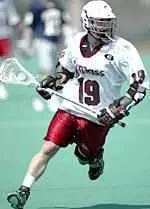
The No. 3 started with All-World attackman Mark Millon. The number two began with Sal LoCascio, who is widely considered to be the greatest goaltender of all-time. The No. 19 will start with Kevin Leveille.
"He's given us another number," says Cannella, while leaning back in his office chair. "Whoever wears that number next, he's going to have to be a very good player."
In an adjacent cubicle, assistant coach Andy Shay overhears the comment and chimes in. "He's not gonna be that good."