University of Massachusets Athletics
UMass' Obi-Wan Kenobi: Feature On Coach Ken O'Brien
October 29, 2006 | Men's Cross Country
Sunday, October 29, 2006
rchimelis@repub.com
AMHERST - He has been coaching cross country and track at the University of Massachusetts since 1968, the year before Julius Erving set foot on campus.
Ken O'Brien has coached Redmen and Minutemen, women and men, indoor and outdoor runners. Versatility has been his strength, as much by necessity as design.
"I like to think I'm pretty good at a lot of things," O'Brien says when forced to speak about his least favorite topic, himself.
"I think that's an underrated skill. There aren't enough people good at doing a lot of different things."
O'Brien's career at UMass, now in its 40th academic year, speaks to such versatility. He coaches three sports - men's indoor and outdoor track, and men's cross country - as does 20-year veteran Julie LaFreniere, who once ran for O'Brien and now coaches the running trifecta on the women's side.
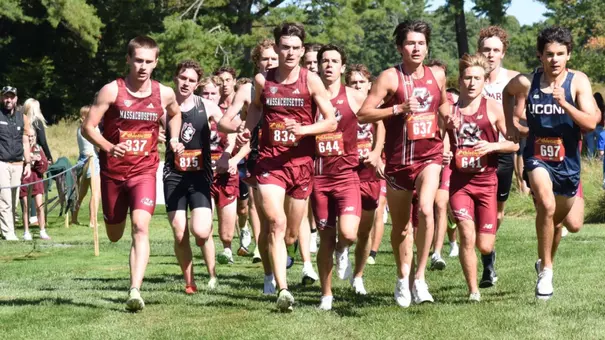
Yesterday at Schenley Park in Pittsburgh, O'Brien's men's cross country team showed it still had that strong finishing kick. In the Atlantic 10 championships, UMass finished third among 14 teams, its best showing since 2001.
But if O'Brien has done it all in his multi-faceted career, he's also seen it all. The fourth head coach in 109 years of UMass track and field, his career serves as a timeline to the school's modern sports history.
"When I ran in college, we had one kid on the team with an auto," said O'Brien, a 1963 UMass graduate. "He'd pick up five of us at a time, drop us off and come back to pick up five more. It was like a relay.
"It's different today. Kids have a lot more options."
What hasn't changed is O'Brien's love of coaching, which has survived his own school's athletic rollercoaster ride. Since 1968, UMass has risen to national sports prominence, fallen back, and stabilized again.
No other UMass coach has experienced those changes for so long, and few have been affected so profoundly.
In a round of draconian cuts, former athletic director Bob Marcum cut several non-revenue sports. One was indoor track, dropped in 2003, but restored a year later, after Marcum had left.
"That was a tough time for me and for the kids in our sports," said O'Brien, who steadfastly refuses Marcum to call by name, only as "the former administrator."
Marcum felt UMass could no longer afford so many sports. But to O'Brien, UMass athletics had always been measured not just by revenue potential, but by competitive and academic success, and by human growth.
"I'd always thought sports like ours were part of that," O'Brien said. "(The cuts) were impossible to explain to the kids."
O'Brien, who praises the support of current UMass administrators, has produced six All-Americans. His teams have ranged from good to outstanding.
He has no idea of his career won-lost record, though. To him, that has never been the point.
"Every year, there's been at least one athlete, often several, who have far exceeded what I expected," he said. "That sort of reinforcement has allowed me to withstand the ups and downs."
What he sees in these traditionally obscure sports is a special form of dedication.
"Our kids don't get the bands and pompoms," O'Brien said. "You might get 50 people to a cross country meet, and (without scholarships), we're sure not buying loyalty to a school. It's up to you to keep yourself honest."
If O'Brien and UMass track have flown under the public radar, its impact has been remarkable. Six of the 23 UMass sports involve running - men's and women's cross country, outdoor and indoor track - and they account for nearly one-fifth of all UMass athletes, about 100 in all.
"He knows how to win in every event," said Zachary Przysiecki, a senior distance runner from Princeton, N.J. "Beyond that, though, he's real. He shapes us in subtle ways."
He's done it with little financial support. Track receives the equivalent of less than one-half of a full scholarship per year, he said, but UMass alumni are rallying to his side.
"Ken is so humble, he's never gone to the alumni, asking for anything," said Jim Hunt, 51, a former UMass half-miler who is leading a fundraising drive for track. "But we're changing the scenery."
Hunt said $600,000 has been pledged by alumni to an endowment drive. Four percent can go to track scholarships, with the rest held in account.
That's welcome help, for recruiting has always been hard.
"We have a great university to sell, but when the question of money came up, I swallowed hard and tried to deflect it," O'Brien said. "I knew we'd be behind."
For a time, O'Brien found one way to catch up.
"John Calipari was putting us on the map, not financially but in terms of exposure," he said. "I started calling recruits when the basketball team was on TV. People knocked over furniture to answer the phone."
Even without such advantages, O'Brien has held his own.
"Coach O'Brien sold the school to me," said Kevin Murphy, a junior distance runner from Bridgewater. "You can talk to him about anything."
His runners say O'Brien persuades athletes to reach high goals without feeling badgered. And finally, help is on the way.
A new track facility was dedicated Sept. 23. There's that growing endowment fund, too.
O'Brien won't reveal his age, but is not planning retirement.
"I think one secret to life is to find a job you're passionate about, and I did," he said. "I didn't plan to stay my entire career here, it's just fallen into place, a subconscious thing. I have no regrets."
Hunt says countless alumni are grateful for that. To them, O'Brien represents the best of what college sports can still be.
"No one in his field is more well-respected than Ken," Hunt said. "He is a true master."