





University of Massachusets Athletics
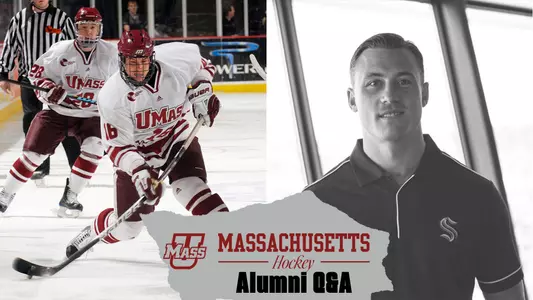
Massachusetts Hockey Alumni Q&A - Minutemen Working In Hockey - Eddie Olczyk
August 28, 2026 | Hockey
Eddie Olczyk played at UMass from 2009-2013 and works as an amateur scout for the NHL's Seattle Kraken
Q: What first got you interested in hockey, and how did your path lead you into scouting?
A: I grew up around the game. My dad played professional hockey for 16 years. We moved around every couple of years to a new city for the team my dad was playing for. I learned to love the game from a young age and always felt like the best version of myself on a hockey team and competing on the ice. My dream, like many other young hockey players, was to play in the NHL but I ultimately fell short of that goal. I played AAA hockey growing up before moving on to play three years in the USHL. From there I was fortunate enough to play college hockey at UMass. After I was done playing, I always knew I wanted to stay in the game. Shortly after college I was lucky enough to get my start in coaching at the age of 25. I received an opportunity to work as an assistant coach for Gary Heenan at D-3 Utica College where I learned a lot about everything. After working at Utica I was hired at Niagara University where I had to adjust to the D-1 landscape. After one season at Niagara I was fortunate enough to be hired at Bemidji State University where I worked for the great Tom Serratore. Working at Bemidji truly helped give me the base for how I see the game, what to look for in players and how to operate. After four great years at Bemidji I was offered a position by Ron Francis to scout for an expansion franchise, the Seattle Kraken. To be able to be a part of a new team from the ground floor, and to work in the NHL to hopefully one day win a Stanley Cup, was an opportunity I couldn't pass up.
Q: How did your own playing experience influence the way you evaluate players now?
A: I think being a former player and knowing what to potentially expect in any given moment while watching a shift helps a lot. When the puck drops you try and predict what a player should or shouldn't do based on your own knowledge and experiences playing the game. I was a bottom six forward who enjoyed killing penalties. I had to rely on my brain and work ethic to be an effective player. I knew that I had to have good reads, habits and detail to stay in the lineup. While scouting I have always have a lot of respect for the highly-skilled players who show that they understand the importance of playing the game the right way all the time. When I see a player forechecking up and down the rink or laying it on the line to block a shot, it always resonates with me.
Q: What are the most important traits you look for when evaluating a player?
A: When I go to a game I'm taking in a lot of different types of information. Skill, skating, hockey sense and compete are four generic categories. Within those categories are a lot of different subcategories that could ultimately propel or deter a player from becoming an NHL'er. You try and decide if the size or strength of the player matters or if it helps or hurts their projection. There's a lot of other things I have to take into consideration during each evaluation as well: strength of the opponent, who is the player paired with or playing with on a line, how much ice time is the player getting, what situations are they being utilized in, etc. It's hard to pinpoint one specific trait that matters most, but I would say consistency is up there. There's no perfect player, but the ones who can have success at each level, are the ones who can impact games consistently with and without the puck.
Q: What separates a good prospect from someone who can actually succeed at the NHL level?
A: Good question, but that depends. There's several factors that are in the player's control (work ethic, skill set, mental toughness, etc.) but there are also several factors that are out of their control. There's a lot of great players who have been drafted or have signed as free agents that do make it, but then there's also players who don't find their way. Say, for example, you have a prospect who is a RW, but the NHL team has heavy depth on the right side. Early on their career they could get stuck in the AHL. In another scenario on a different team that same player could get a faster opportunity to play in the NHL because the team has a major need at that same position. Depth charts can play a major factor in how quickly a player enters the league, but it's also on the player to take advantage of any opportunity they're given to force the hand of decision makers.
Q: How much do intangibles (like work ethic and leadership) matter compared to pure talent?
A: They matter a ton. You need skill and talent to win, but a lot of high-performing teams and organizations prioritize character and culture as the cornerstone of their success. It could be the difference of a player being drafted or being removed entirely from an NHL organization's list. It could help or prevent a player who is an unrestricted free agent have multiple options in the summer versus just a few. If it's player for player, the one who is willing to do the right things on and off the ice and help uphold the standard is usually the more desirable player. High character players who are leaders can positively influence other players around them to sustain or improve the culture.
Q: What does a typical day or week look like for you during the scouting season?
A: My territory is the entire Unites States. I am responsible for scouting any draft eligible player who is playing high school, prep school, AAA hockey, junior hockey or NCAA. I am also responsible for scouting and identifying NCAA college free agents as well. I am usually traveling 2-4 days a week. Each month I average anywhere from 15-20 days on the road. My scouting season runs from September to May with September, October, December and March being the busiest months. Being based in Chicago I can take a lot of direct flights and don't spend too much time driving long distances. This gives me the flexibility to take a later flight from home or get home earlier to be able to spend time with my wife and three kids.
Q: How has scouting changed in recent years with analytics becoming more important?
A: The one thing I would say is that there is more information available than ever before. It's great when scouts and analytics agree, but that's not always the case.
Q: What trends are you seeing in younger players coming up today?
A: I would say it's probably the ability to handle adversity. Develop now to win later philosophy seems to be getting a little lost across all youth sports. Everybody wants to win and win often. With that, potential players are getting weeded out while others are always looking for the next best thing. It's a fine line between new opportunity and going through hard things to develop and mature as a person.
Q: What advice would you give to someone who wants to work in scouting or hockey operations?
A: Don't be afraid to reach out to ask for advice or help. There are so many different levels in hockey from high school, prep school, AAA to junior and college. There's a lot of great people who are in coaching or scouting. Those same people were also once looking to break in and would be happy to connect or take a call. The other thing I would say is that it doesn't just happen overnight...it can be a grind. Depending on an individual's path it can take many years to climb to where you want to get to, but if you have a passion for the game and you can remain patient, then it's worth it.
What's the most underrated quality in a player that people don't talk about enough?
A: We've touched on this in terms of work ethic, but for me it's being hard to play against. There's not as many natural "throwback" or "hard skill" players nowadays. These are the type of players you want in your foxhole. The kind who are all in all the time no matter if things are going great or poorly. They are willing to do the little things right and do the hard work others aren't willing to do. They can drag their teammates into the fight and are willing to do whatever it takes to win.
Q: What first got you interested in hockey, and how did your path lead you into scouting?
A: I grew up around the game. My dad played professional hockey for 16 years. We moved around every couple of years to a new city for the team my dad was playing for. I learned to love the game from a young age and always felt like the best version of myself on a hockey team and competing on the ice. My dream, like many other young hockey players, was to play in the NHL but I ultimately fell short of that goal. I played AAA hockey growing up before moving on to play three years in the USHL. From there I was fortunate enough to play college hockey at UMass. After I was done playing, I always knew I wanted to stay in the game. Shortly after college I was lucky enough to get my start in coaching at the age of 25. I received an opportunity to work as an assistant coach for Gary Heenan at D-3 Utica College where I learned a lot about everything. After working at Utica I was hired at Niagara University where I had to adjust to the D-1 landscape. After one season at Niagara I was fortunate enough to be hired at Bemidji State University where I worked for the great Tom Serratore. Working at Bemidji truly helped give me the base for how I see the game, what to look for in players and how to operate. After four great years at Bemidji I was offered a position by Ron Francis to scout for an expansion franchise, the Seattle Kraken. To be able to be a part of a new team from the ground floor, and to work in the NHL to hopefully one day win a Stanley Cup, was an opportunity I couldn't pass up.
Q: How did your own playing experience influence the way you evaluate players now?
A: I think being a former player and knowing what to potentially expect in any given moment while watching a shift helps a lot. When the puck drops you try and predict what a player should or shouldn't do based on your own knowledge and experiences playing the game. I was a bottom six forward who enjoyed killing penalties. I had to rely on my brain and work ethic to be an effective player. I knew that I had to have good reads, habits and detail to stay in the lineup. While scouting I have always have a lot of respect for the highly-skilled players who show that they understand the importance of playing the game the right way all the time. When I see a player forechecking up and down the rink or laying it on the line to block a shot, it always resonates with me.
Q: What are the most important traits you look for when evaluating a player?
A: When I go to a game I'm taking in a lot of different types of information. Skill, skating, hockey sense and compete are four generic categories. Within those categories are a lot of different subcategories that could ultimately propel or deter a player from becoming an NHL'er. You try and decide if the size or strength of the player matters or if it helps or hurts their projection. There's a lot of other things I have to take into consideration during each evaluation as well: strength of the opponent, who is the player paired with or playing with on a line, how much ice time is the player getting, what situations are they being utilized in, etc. It's hard to pinpoint one specific trait that matters most, but I would say consistency is up there. There's no perfect player, but the ones who can have success at each level, are the ones who can impact games consistently with and without the puck.
Q: What separates a good prospect from someone who can actually succeed at the NHL level?
A: Good question, but that depends. There's several factors that are in the player's control (work ethic, skill set, mental toughness, etc.) but there are also several factors that are out of their control. There's a lot of great players who have been drafted or have signed as free agents that do make it, but then there's also players who don't find their way. Say, for example, you have a prospect who is a RW, but the NHL team has heavy depth on the right side. Early on their career they could get stuck in the AHL. In another scenario on a different team that same player could get a faster opportunity to play in the NHL because the team has a major need at that same position. Depth charts can play a major factor in how quickly a player enters the league, but it's also on the player to take advantage of any opportunity they're given to force the hand of decision makers.
Q: How much do intangibles (like work ethic and leadership) matter compared to pure talent?
A: They matter a ton. You need skill and talent to win, but a lot of high-performing teams and organizations prioritize character and culture as the cornerstone of their success. It could be the difference of a player being drafted or being removed entirely from an NHL organization's list. It could help or prevent a player who is an unrestricted free agent have multiple options in the summer versus just a few. If it's player for player, the one who is willing to do the right things on and off the ice and help uphold the standard is usually the more desirable player. High character players who are leaders can positively influence other players around them to sustain or improve the culture.
Q: What does a typical day or week look like for you during the scouting season?
A: My territory is the entire Unites States. I am responsible for scouting any draft eligible player who is playing high school, prep school, AAA hockey, junior hockey or NCAA. I am also responsible for scouting and identifying NCAA college free agents as well. I am usually traveling 2-4 days a week. Each month I average anywhere from 15-20 days on the road. My scouting season runs from September to May with September, October, December and March being the busiest months. Being based in Chicago I can take a lot of direct flights and don't spend too much time driving long distances. This gives me the flexibility to take a later flight from home or get home earlier to be able to spend time with my wife and three kids.
Q: How has scouting changed in recent years with analytics becoming more important?
A: The one thing I would say is that there is more information available than ever before. It's great when scouts and analytics agree, but that's not always the case.
Q: What trends are you seeing in younger players coming up today?
A: I would say it's probably the ability to handle adversity. Develop now to win later philosophy seems to be getting a little lost across all youth sports. Everybody wants to win and win often. With that, potential players are getting weeded out while others are always looking for the next best thing. It's a fine line between new opportunity and going through hard things to develop and mature as a person.
Q: What advice would you give to someone who wants to work in scouting or hockey operations?
A: Don't be afraid to reach out to ask for advice or help. There are so many different levels in hockey from high school, prep school, AAA to junior and college. There's a lot of great people who are in coaching or scouting. Those same people were also once looking to break in and would be happy to connect or take a call. The other thing I would say is that it doesn't just happen overnight...it can be a grind. Depending on an individual's path it can take many years to climb to where you want to get to, but if you have a passion for the game and you can remain patient, then it's worth it.
What's the most underrated quality in a player that people don't talk about enough?
A: We've touched on this in terms of work ethic, but for me it's being hard to play against. There's not as many natural "throwback" or "hard skill" players nowadays. These are the type of players you want in your foxhole. The kind who are all in all the time no matter if things are going great or poorly. They are willing to do the little things right and do the hard work others aren't willing to do. They can drag their teammates into the fight and are willing to do whatever it takes to win.
Saturday, October 10
Saturday, October 10
Saturday, October 10
Friday, October 09