







University of Massachusets Athletics
Hockey According to Hixon
January 01, 1986 | Field Hockey
Another Big Year for the Nationally Ranked Field Hockey Team
Archives Note: The following article appeared in the Winter 1986 issue of Contact, the former University of Massachusetts campus newsmagazine. The issue went to print in Fall 1985.
Patricia Wright | Contact
If I doubted it before I watched my first hockey match, I didn't doubt it by the time the game was through. It's sad but true: field hockey players and I are a different breed of biped. What Pam Hixon's Minutewomen have got, I haven't.
I don't mean just youth, strength, and speed. I don't mean the coordination that can get something accomplished with a hockey stick in that turf-level tangle of feet and ball and clattering hardwood.
I don't mean the stamina that keeps players pounding up and down a 100-yard field through an uninterrupted 35-minute half. I don't even mean desire.
I mean the ability to think - fast and in four dimensions - while running hell-bent-for-leather with a yardlong stick in your hand, intent on delivering to its goal a rock-hard, baseball-sized white projectile that's being whacked every which way by a dozen other running women, similarly armed, similarly determined, and only half of them on your side.
It's like playing golf at a dead run, observes Pam Hixon, coach of the university's nationally ranked women's field hockey team since 1978. At a dead run, and in groups, and within a very restricted time frame. The ability to think quickly is everything.
"Decision-making is the biggest part of this game," said Hixon. "Most of these kids already have the skills to play the game. They may not be as rdined as they would be on the national level, but they can stop a ball, they can hit a ball, they can pass it, they can dribble it, they can do all those things.
"What separates the great players from the good players is their ability to think. How quickly they can read a situation, assess a situation, make a decision - and then do it. The longer it takes you to make a decision, the less time you have to do something about it. And once you do something it might be too late!"
Two-and-a-half hours a day, six days a week, from late August to well into November, the Minutewomen are either competing in scheduled matches - 19 in 9 weeks in 1985 - or they're out on Totman field plowing through the practice drills and scrimmages that will prepare them, Hixon hopes, to trust themselves and each other to make the right decisions in game situations.
They've got to be able to run and run hard, but that isn't the half of it. They've got to sprint behind a dribbled ball, they've got to scuttle sideways and backwards when play bunches up, they've got to switch speeds and directions at will. They've got to be masters of long drives and passes - spectacular strokes, often taken on the run as play sweeps down the field like horseless polo. They must maintain an intricate arsenal of flicks and scoops, stops and cuts, lunges and "tackles" - all executed with the hooked hardwood stick in a game that tries very hard not to be a contact sport. And because no game played at this pace can fail to bring players into contact with each other or at least with the ground, they've got to be able to duck, to slide, to roll, to recover and run again.
"Yeah, I think it's pretty demanding," Hixon agrees. "But they're trained for it. And training's a very scientific process now. We're doing weight training and specific running styles and all that kind of stuff. We don't just throw them out there and tell them to go."
Injury is infrequent and minor, she says. "Some blacks and blues, that's about it. We wear shin guards, and that protects them from the ankle to the leg. And basically the ball stays on the ground." Just in case the ball lofts, and because accidental collision is always a possibility, the players pelt up and down the field with plastic mouthguards gripped in their teeth. "Just for precaution," says Hixon. "No reason to lose a tooth if you don't have to."
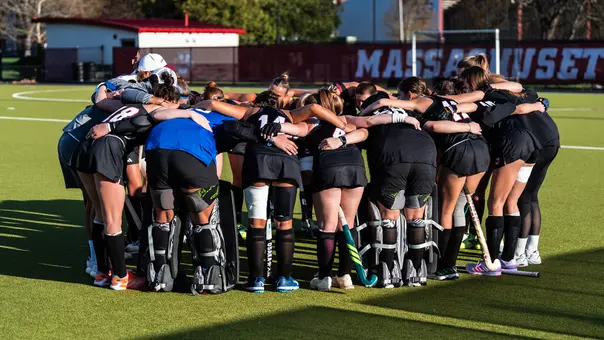
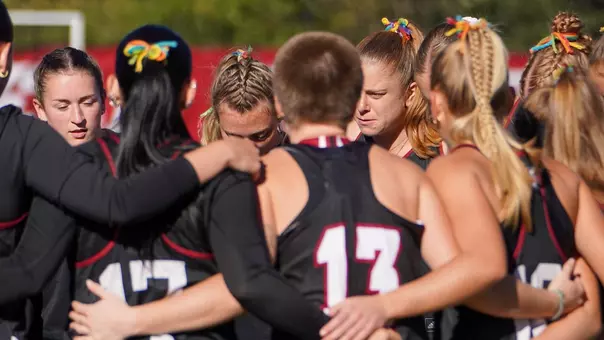
Every precaution observed, as much practice as possible under their belts, last minute advice and instructions taken, the Minutewomen start each match in a sort of endearing puppy huddle: leaning together in a clump, hands piled up in the center, getting a last psychological stroke from their coach. She huddles with them, addressing them collectively and with some intensity as "Mass." "Okay, Mass. This is it, Mass. Let's do it!"
Looking at athletes, in whom human thought is so fluently transformed into physical action, it's hard for nonathletes not to think of other animals. Field hockey players call up equine associations: the flatout gallop of the attacking team, the goalie stamping and pawing like an armored pony. The appropriate animal metaphor for the field hockey coach no doubt varies by size, style, and gender. For Pam Hixon, I'd think of a very alert and intelligent terrier.
Hixon is a small, wiry, Framingham native whose father played semiprofessional ice hockey. She was on the ice with a stick in her hand by the time she was three years old. There were no opportunities to speak of for women in ice hockey at the time, so she turned to field hockey as an adolescent, and her interest in the game has never waned. She played through high school, played through college, played 10 years on the national amateur team; after her retirement from national competition in 1979, she got involved with the Olympic developmental program.
Her commitment to the sport led to a chance to travel to Holland with the second U.S. women's Olympic field hockey team in the spring of 1984, and to be with them as a volunteer assistant coach at the Los Angeles summer games. Her commitment is probably also reflected in the fact that Massachusetts went to the national championships in six of Hixon's first seven years as coach. Three times the team has finished among the top four teams in the country, and in 1981 it finished second. As Contact went to press this fall, the 1985 team was number 5 in the Division One rankings.
The overall goal every season is to make it into the top 12 and qualify for the championships. In the complex ranking system employed by the NCAA field hockey committee, every point in every game counts toward that goal. So even if field hockey were rich in contemplative pauses, Hixon wouldn't relax for a moment.
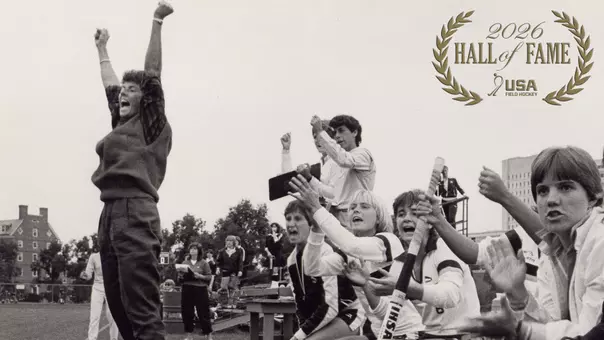
She isn't a relaxed coach, but she isn't a histrionic one either. Just very alert. As her players charge up and down the field she mostly stands near the bench, or paces a little. She claps and cheers when her players do well and may leap into the air when they score a goal, but mostly she stands with her hands clasped behind her back or in the pockets of her pleated trousers. Her eyes never leave the field, however, and every hair is alert. If she really were a terrier, her ears would be pricked.
She directs a certain amount of calculated grousing at the officials. "They have a term in athletics which is 'working the referees.' I do that. I admit it." Working the referees can be one aspect of the psychological game, she says, "depending on the complexion of the game and sometimes on how my team is responding. If they're very lackadaisical, it might take me, you know, to jump on an official to perk them up."
Most of her communication with the players is more direct. She shouts words of instruction or praise to the field players. "Read it Tonia! Read it, read itr' "Nice try Chris, way to be there." "Who ya got! Who's on 9, who's on 8, who's on 4t She frequently talks to the reserve players about what's going on in the game - using the game as she would a training film or any other teaching device.
"Coaching is just a different kind of teaching," she says later in her office in the Boyden building. "You have to be a teacher of individuals, you have to teach them individual skills. But then you have to go beyond that and bring large groups of people together to work for a common goal. If you're teaching in the classroom, you're really only concerned with individuals and what they learn. You don't have to get those people to work together to make anything happen!"
On a stylistic scale of my amateur devising, with, say, Billy Martin at one end and Bing Crosby at the other, Pam Hixon's coaching style leans in the mellow parish priest direction. Mellow is not really the word to describe her, but she tries to make things happen through positive reinforcement, instructional feedback, and a certain degree of affection. She does what she does partly because it works, and partly because that's the way she is.
"You know you can't go outside
your personality," she says. "I think that's really a big mistake. No. You're either Bing Crosby or you're not Bing Crosby, that's it."
There's a basic inappropriateness, of course, in these comparisons with mythic male coaching styles. Field hockey in America is predominantly a women's sport. Bing Crosby puffing on his pipe or Billy Martin kicking dirt on an umpire are almost equally incongruous images in a sport introduced into the United States by Miss Constance M.K. Applebee.
Miss Applebee was an Englishwoman who spent the summer of 1901 at Harvard, studying the science of human measurement. So intrigued were some of her colleagues by the game she demonstrated with makeshift equipment on a concrete court outside the Harvard gym, that she was invited to teach field hockey that fall to the young ladies of Vassar College. It is recorded that Miss Applebee had a devil of a time finding equipment for her course of instruction. She finally arrived in Poughkeepsie with a cricket ball and 24 hockey sticks abandoned in New York by an Englishman who'd tried unsuccessfully to promote field hockey among American men.
Perhaps they were too busy with the new native sports of baseball and basketball, perhaps there was some more metaphysical reason. At any rate, though field hockey originated as a men's sport in Europe and was played by both sexes in Britain, American men have never taken to it in any great numbers. Male interest does exist in this country: both men and women play at the club sport level, and the U.S. sponsors a men's Olympic field hockey team. Overridingly, though, field hockey in America is the game for women that Constance Applebee taught first at Vassar, later at Wellesley, Radcliffe, Smith, and Mount Holyoke, finally at Bryn Mawr where she held sway for a generation as games mistress. The nurturing of field hockey in private women's schools seems to have stamped the American game with a female image - as well as with, perhaps, vaguely privileged associations of private education and kilts.
Neither privilege nor kilts has anything to do, necessarily, with modem intercollegiate field hockey. The Ivy League is the weakest league in Division One, says Hixon. The Seven Sisters are in a separate and less competitive league altogether. And the Minutewomen, at least, have opted out of kilts.
But it's still a woman-identified sport. Hixon sympathizes with men who have limited opportunity to play. Interested male students have had to be turned away from her team - especially students from countries like India and Pakistan, where, thanks to the British Army's masculine equivalents of Miss Applebee, field hockey has become the national sport. There is frustration among the few American high school boys who've so far felt inclined to play the game; Northampton High School's decision to allow three boys to join a formerly all-girls field hockey team, and to compete in an otherwise allgirls league, gained national attention this fall.
"Here it hasn't been a problem, because the sport is clearly identified by the NCAA as women's field hockey. The sport is not field hockey or coed field hockey, it's women's field hockey. I suppose if someone took the NCAA to court, they might have a case. But why bother?
"I choose my teams; what we're really doing is providing women the opportunity to play a sport that they are good at. They're recruited athletes; some of them are on scholarships; I'm certainly not going to leave them behind to make room for some guy who walks in off the street, or picks it up in a gym class."
Spectators around me in the Totman field bleachers mutter nervously when the game has been stalled for too many minutes near the goal that the Minutewomen are defending. These are the hometeam partisans, happiest when the Minutewomen have the visiting team bunched frantically up around its goal. They may also be aficionados, more sensitive than I to the intricacies of congested play.
But I like it best when the play comes lunging down the field close by the bleachers, whichever way it's going. It's then, in the panting of the players and the thud of their cleated shoes, the sight of chipped turf flying and the solid thwacking sound of the driven ball, that the intense physicality and speed of field hockey are most strongly borne home to the spectator.
Every sport has its special demands and produces its special metaphors. Every sport has been used as a metaphor for life, but surely they are metaphors for very different kinds of life. For 70 minutes on an autumn afternoon - until the buzzer sounds and they slap hands in congratulation or commiseration and huddle for their closing good-children's chant ...
"GOOD GAME B.C./THANK YOU OFFICIALS/GO UMASS!" - for 70 minutes the women on Totman field are giving everything they've got to field hockey. The game will tax not only their bodies but their wills in different ways than would the most intense game of golf, or long-distance footrace, or performance on a rowing crew.
Two of the most persistent categories of advice that Pam Hixon shouts from the bench, impresses on the reserves, and drums into the team at practice and video-watching sessions, could be summarized as follows. One, watch what you're doing - often expressed in the shout, "DON'T RUSH!" And two, rely on your team - often expressed in the shout, "WHERE'S YOUR HELP!"
Hixon is aware of the seeming incongruousness of bellowing "DON'T RUSH," into the hurly-burly of a field hockey match. But, she says, "we try to encourage them to have as much inner poise as they can - even when there's a lot of things going on around them.
"They have to do things in sequence. You can't be thinking, 'I'm going to put the ball in the net' before you have the ball on your stick. You have to get it first and know that everything happens one thing after the next. You have to field it before you can dribble it, and you have to get by this defender before you can take the shot. If you rush, if you try to do too many things all at one time, you'll never do the first thing you need to get done. Which is probably to get the ball.
"I think there are some lifetime principles that are involved. Like concentration, and discipline, and also working together. These are important factors, not only for the team to function, but for individuals to learn. When they leave the team, when they leave college, I think they're going to have a very good foundation to become working members of society. They know how to work with people already. "I think that's an advantage that women have being athletes that they don't get just being part of the student body. So I think we're preparing them, yeah, for sports, but also for the long term. I like to think that is true."
About the Archives
This is a digitized version of a press release from the University of Massachusetts archives, before the start of online publication. To preserve these articles as they originally appeared, UMass does not alter, edit or update them. Occasionally the digitization process introduces transcription errors or other items. Please send reports of such problems to the appropriate sport contact in the UMass Athletic Communications office.
Patricia Wright | Contact
If I doubted it before I watched my first hockey match, I didn't doubt it by the time the game was through. It's sad but true: field hockey players and I are a different breed of biped. What Pam Hixon's Minutewomen have got, I haven't.
I don't mean just youth, strength, and speed. I don't mean the coordination that can get something accomplished with a hockey stick in that turf-level tangle of feet and ball and clattering hardwood.
I don't mean the stamina that keeps players pounding up and down a 100-yard field through an uninterrupted 35-minute half. I don't even mean desire.
I mean the ability to think - fast and in four dimensions - while running hell-bent-for-leather with a yardlong stick in your hand, intent on delivering to its goal a rock-hard, baseball-sized white projectile that's being whacked every which way by a dozen other running women, similarly armed, similarly determined, and only half of them on your side.
It's like playing golf at a dead run, observes Pam Hixon, coach of the university's nationally ranked women's field hockey team since 1978. At a dead run, and in groups, and within a very restricted time frame. The ability to think quickly is everything.
"Decision-making is the biggest part of this game," said Hixon. "Most of these kids already have the skills to play the game. They may not be as rdined as they would be on the national level, but they can stop a ball, they can hit a ball, they can pass it, they can dribble it, they can do all those things.
"What separates the great players from the good players is their ability to think. How quickly they can read a situation, assess a situation, make a decision - and then do it. The longer it takes you to make a decision, the less time you have to do something about it. And once you do something it might be too late!"
Two-and-a-half hours a day, six days a week, from late August to well into November, the Minutewomen are either competing in scheduled matches - 19 in 9 weeks in 1985 - or they're out on Totman field plowing through the practice drills and scrimmages that will prepare them, Hixon hopes, to trust themselves and each other to make the right decisions in game situations.
They've got to be able to run and run hard, but that isn't the half of it. They've got to sprint behind a dribbled ball, they've got to scuttle sideways and backwards when play bunches up, they've got to switch speeds and directions at will. They've got to be masters of long drives and passes - spectacular strokes, often taken on the run as play sweeps down the field like horseless polo. They must maintain an intricate arsenal of flicks and scoops, stops and cuts, lunges and "tackles" - all executed with the hooked hardwood stick in a game that tries very hard not to be a contact sport. And because no game played at this pace can fail to bring players into contact with each other or at least with the ground, they've got to be able to duck, to slide, to roll, to recover and run again.
"Yeah, I think it's pretty demanding," Hixon agrees. "But they're trained for it. And training's a very scientific process now. We're doing weight training and specific running styles and all that kind of stuff. We don't just throw them out there and tell them to go."
Injury is infrequent and minor, she says. "Some blacks and blues, that's about it. We wear shin guards, and that protects them from the ankle to the leg. And basically the ball stays on the ground." Just in case the ball lofts, and because accidental collision is always a possibility, the players pelt up and down the field with plastic mouthguards gripped in their teeth. "Just for precaution," says Hixon. "No reason to lose a tooth if you don't have to."
Every precaution observed, as much practice as possible under their belts, last minute advice and instructions taken, the Minutewomen start each match in a sort of endearing puppy huddle: leaning together in a clump, hands piled up in the center, getting a last psychological stroke from their coach. She huddles with them, addressing them collectively and with some intensity as "Mass." "Okay, Mass. This is it, Mass. Let's do it!"
Looking at athletes, in whom human thought is so fluently transformed into physical action, it's hard for nonathletes not to think of other animals. Field hockey players call up equine associations: the flatout gallop of the attacking team, the goalie stamping and pawing like an armored pony. The appropriate animal metaphor for the field hockey coach no doubt varies by size, style, and gender. For Pam Hixon, I'd think of a very alert and intelligent terrier.
Hixon is a small, wiry, Framingham native whose father played semiprofessional ice hockey. She was on the ice with a stick in her hand by the time she was three years old. There were no opportunities to speak of for women in ice hockey at the time, so she turned to field hockey as an adolescent, and her interest in the game has never waned. She played through high school, played through college, played 10 years on the national amateur team; after her retirement from national competition in 1979, she got involved with the Olympic developmental program.
Her commitment to the sport led to a chance to travel to Holland with the second U.S. women's Olympic field hockey team in the spring of 1984, and to be with them as a volunteer assistant coach at the Los Angeles summer games. Her commitment is probably also reflected in the fact that Massachusetts went to the national championships in six of Hixon's first seven years as coach. Three times the team has finished among the top four teams in the country, and in 1981 it finished second. As Contact went to press this fall, the 1985 team was number 5 in the Division One rankings.
The overall goal every season is to make it into the top 12 and qualify for the championships. In the complex ranking system employed by the NCAA field hockey committee, every point in every game counts toward that goal. So even if field hockey were rich in contemplative pauses, Hixon wouldn't relax for a moment.
She isn't a relaxed coach, but she isn't a histrionic one either. Just very alert. As her players charge up and down the field she mostly stands near the bench, or paces a little. She claps and cheers when her players do well and may leap into the air when they score a goal, but mostly she stands with her hands clasped behind her back or in the pockets of her pleated trousers. Her eyes never leave the field, however, and every hair is alert. If she really were a terrier, her ears would be pricked.
She directs a certain amount of calculated grousing at the officials. "They have a term in athletics which is 'working the referees.' I do that. I admit it." Working the referees can be one aspect of the psychological game, she says, "depending on the complexion of the game and sometimes on how my team is responding. If they're very lackadaisical, it might take me, you know, to jump on an official to perk them up."
Most of her communication with the players is more direct. She shouts words of instruction or praise to the field players. "Read it Tonia! Read it, read itr' "Nice try Chris, way to be there." "Who ya got! Who's on 9, who's on 8, who's on 4t She frequently talks to the reserve players about what's going on in the game - using the game as she would a training film or any other teaching device.
"Coaching is just a different kind of teaching," she says later in her office in the Boyden building. "You have to be a teacher of individuals, you have to teach them individual skills. But then you have to go beyond that and bring large groups of people together to work for a common goal. If you're teaching in the classroom, you're really only concerned with individuals and what they learn. You don't have to get those people to work together to make anything happen!"
On a stylistic scale of my amateur devising, with, say, Billy Martin at one end and Bing Crosby at the other, Pam Hixon's coaching style leans in the mellow parish priest direction. Mellow is not really the word to describe her, but she tries to make things happen through positive reinforcement, instructional feedback, and a certain degree of affection. She does what she does partly because it works, and partly because that's the way she is.
"You know you can't go outside
your personality," she says. "I think that's really a big mistake. No. You're either Bing Crosby or you're not Bing Crosby, that's it."
There's a basic inappropriateness, of course, in these comparisons with mythic male coaching styles. Field hockey in America is predominantly a women's sport. Bing Crosby puffing on his pipe or Billy Martin kicking dirt on an umpire are almost equally incongruous images in a sport introduced into the United States by Miss Constance M.K. Applebee.
Miss Applebee was an Englishwoman who spent the summer of 1901 at Harvard, studying the science of human measurement. So intrigued were some of her colleagues by the game she demonstrated with makeshift equipment on a concrete court outside the Harvard gym, that she was invited to teach field hockey that fall to the young ladies of Vassar College. It is recorded that Miss Applebee had a devil of a time finding equipment for her course of instruction. She finally arrived in Poughkeepsie with a cricket ball and 24 hockey sticks abandoned in New York by an Englishman who'd tried unsuccessfully to promote field hockey among American men.
Perhaps they were too busy with the new native sports of baseball and basketball, perhaps there was some more metaphysical reason. At any rate, though field hockey originated as a men's sport in Europe and was played by both sexes in Britain, American men have never taken to it in any great numbers. Male interest does exist in this country: both men and women play at the club sport level, and the U.S. sponsors a men's Olympic field hockey team. Overridingly, though, field hockey in America is the game for women that Constance Applebee taught first at Vassar, later at Wellesley, Radcliffe, Smith, and Mount Holyoke, finally at Bryn Mawr where she held sway for a generation as games mistress. The nurturing of field hockey in private women's schools seems to have stamped the American game with a female image - as well as with, perhaps, vaguely privileged associations of private education and kilts.
Neither privilege nor kilts has anything to do, necessarily, with modem intercollegiate field hockey. The Ivy League is the weakest league in Division One, says Hixon. The Seven Sisters are in a separate and less competitive league altogether. And the Minutewomen, at least, have opted out of kilts.
But it's still a woman-identified sport. Hixon sympathizes with men who have limited opportunity to play. Interested male students have had to be turned away from her team - especially students from countries like India and Pakistan, where, thanks to the British Army's masculine equivalents of Miss Applebee, field hockey has become the national sport. There is frustration among the few American high school boys who've so far felt inclined to play the game; Northampton High School's decision to allow three boys to join a formerly all-girls field hockey team, and to compete in an otherwise allgirls league, gained national attention this fall.
"Here it hasn't been a problem, because the sport is clearly identified by the NCAA as women's field hockey. The sport is not field hockey or coed field hockey, it's women's field hockey. I suppose if someone took the NCAA to court, they might have a case. But why bother?
"I choose my teams; what we're really doing is providing women the opportunity to play a sport that they are good at. They're recruited athletes; some of them are on scholarships; I'm certainly not going to leave them behind to make room for some guy who walks in off the street, or picks it up in a gym class."
Spectators around me in the Totman field bleachers mutter nervously when the game has been stalled for too many minutes near the goal that the Minutewomen are defending. These are the hometeam partisans, happiest when the Minutewomen have the visiting team bunched frantically up around its goal. They may also be aficionados, more sensitive than I to the intricacies of congested play.
But I like it best when the play comes lunging down the field close by the bleachers, whichever way it's going. It's then, in the panting of the players and the thud of their cleated shoes, the sight of chipped turf flying and the solid thwacking sound of the driven ball, that the intense physicality and speed of field hockey are most strongly borne home to the spectator.
Every sport has its special demands and produces its special metaphors. Every sport has been used as a metaphor for life, but surely they are metaphors for very different kinds of life. For 70 minutes on an autumn afternoon - until the buzzer sounds and they slap hands in congratulation or commiseration and huddle for their closing good-children's chant ...
"GOOD GAME B.C./THANK YOU OFFICIALS/GO UMASS!" - for 70 minutes the women on Totman field are giving everything they've got to field hockey. The game will tax not only their bodies but their wills in different ways than would the most intense game of golf, or long-distance footrace, or performance on a rowing crew.
Two of the most persistent categories of advice that Pam Hixon shouts from the bench, impresses on the reserves, and drums into the team at practice and video-watching sessions, could be summarized as follows. One, watch what you're doing - often expressed in the shout, "DON'T RUSH!" And two, rely on your team - often expressed in the shout, "WHERE'S YOUR HELP!"
Hixon is aware of the seeming incongruousness of bellowing "DON'T RUSH," into the hurly-burly of a field hockey match. But, she says, "we try to encourage them to have as much inner poise as they can - even when there's a lot of things going on around them.
"They have to do things in sequence. You can't be thinking, 'I'm going to put the ball in the net' before you have the ball on your stick. You have to get it first and know that everything happens one thing after the next. You have to field it before you can dribble it, and you have to get by this defender before you can take the shot. If you rush, if you try to do too many things all at one time, you'll never do the first thing you need to get done. Which is probably to get the ball.
"I think there are some lifetime principles that are involved. Like concentration, and discipline, and also working together. These are important factors, not only for the team to function, but for individuals to learn. When they leave the team, when they leave college, I think they're going to have a very good foundation to become working members of society. They know how to work with people already. "I think that's an advantage that women have being athletes that they don't get just being part of the student body. So I think we're preparing them, yeah, for sports, but also for the long term. I like to think that is true."
About the Archives
This is a digitized version of a press release from the University of Massachusetts archives, before the start of online publication. To preserve these articles as they originally appeared, UMass does not alter, edit or update them. Occasionally the digitization process introduces transcription errors or other items. Please send reports of such problems to the appropriate sport contact in the UMass Athletic Communications office.

Saturday, October 25
Friday, October 24
Monday, October 13
Wednesday, October 08