




University of Massachusets Athletics
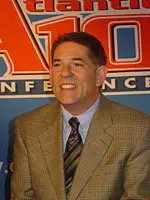
USA Today Feature: UMass Coach Banking On Revival
November 29, 2004 | Men's Basketball
Nov. 29, 2004
Originally Published In USA Today on Nov. 23
By Malcolm Moran, USA TODAY
AMHERST, Mass. -- The University of Massachusetts, after enduring a .312 winning percentage throughout the 1980s, became the No. 1-ranked men's basketball team for the first time shortly after a 24-point win against defending national champion Arkansas on Nov. 25, 1994.
A decade after Massachusetts completed one of the most unpredictable ascensions in the modern history of college basketball, another group of Minutemen is working to extend a coach's stay.
These Minutemen, after three consecutive losing seasons under Steve Lappas, will play for a coach whose conviction about the team's future is so strong that it inspired a unique agreement with athletics director John McCutcheon in March.
Lappas agreed to eliminate the last two years of his contract for the chance to negotiate a new deal based on the results of the season that began Nov. 23 against Birmingham Southern.
"I'm comfortable because I believe in what we've got here," Lappas says. "I've seen it before. If I didn't see it, I could have left. But I wasn't leaving this team to somebody else, no.
"My assistants and me, we built this thing with our blood, and we're going to show people that we know where we're headed and what we're doing here. The one thing I can tell you is I know what I see."
An office wall displays a poster from the 1996 Final Four, the eventual climax of the rise of the Minutemen under John Calipari. The poster represents an impressive element in the Massachusetts sales pitch and the burden created by the days when the 9,493-seat Mullins Center was filled every game.
It recalls a time when Calipari put the zoo in ZooMass by convincing a once-passive audience to put basketballs on their heads. When the then-No. 1 Razorbacks went down, and hard, on their way to a spot in the 1995 national championship game. Ten years ago.
"Is it?" Calipari said recently. "Wow."
After a 10-19 season and 34-54 record in three years, Lappas explains how a No. 1 ranking and eventual Final Four appearance relates to this time and team. He reaches back to his days at Bronx High School of Science as a point guard surrounded by geniuses.
"The bar doesn't necessarily have to be a real bar," Lappas says. "You know how they do things when you're in mechanical drawing as a kid? In mechanical drawing, they do dots on what you can't see. The bar is kind of dotted, you know what I mean? You can't really see it, but it's there."
 |
Salesman legacy lasts
When Steve Lappas became the Massachusetts coach in 2001, he inherited a team with a 15-15 record, three seasons removed from a seven-year NCAA tournament streak. He also inherited touchtone telephones. This was once a luxury item on the UMass campus. John Calipari's eight-season run, beginning in 1988, included a recruiting effort that took place one rotary dial at a time. "You dialed four numbers, and then you dialed the seven-digit code and it came up busy," Calipari, now the Memphis coach, remembered. "Or you missed one number. I said, 'We're spending two hours a day dialing. Not talking. Dialing.' " The rise of the Minutemen to a No. 1 ranking in late November 1994 included Calipari's unorthodox entrepreneurial skills. "Every time we traveled in the state, we'd stop in a sporting goods store and we'd ask, specifically, for 20 UMass shirts, sweaters and hats," Calipari said. "We'd say, 'You don't have any? OK, do you know who would have this stuff? Because I really want to order it.' " Steve Lappas, the coach of the Minutemen, understands the Calipari legacy is built upon 264 victories in eight seasons, second to Jack Leaman's 343 victories in 13 years. Calipari's teams won five Atlantic 10 regular-season championships and five conference tournament championships. "He was a great salesperson," Lappas said. "But no win, no sell. He was selling something that was pointed in the right direction. All those stories about buying kids pizzas and stuff, they become folklore if you win. "If you lose and you try to do the same thing, people will say you're not doing anything." --By Malcolm Moran
|
'There' for his players
McCutcheon's presence is a sign of the instability the department has faced. McCutcheon is the sixth permanent athletics director since 1911. He is the third since 2002. Including two interims, Lappas has worked for five athletics directors.
A team that counted on three freshmen and a sophomore, a result of departures from Lappas' initial recruiting class, lost eight of its final nine games last season.
It was then, as speculation about his future intensified, that Lappas says he saw a consistent effort from a team with less and less to play for. The criticism was growing louder.
"About me," Lappas says. "About them. About everything. No. We kept it together. That's when I knew. It's funny. You're going through a tough stretch, and that's when you knew."
Soon after last season, following McCutcheon's arrival in February, the athletics director met privately with each player.
"It was all confidential," four-year starting point guard Anthony Anderson says. "I personally think everybody pushed for Coach Lap. We know how good we can be with him. He was put in a situation that was already bad. Give him time to do what he has to do. Now that he has all of his guys and all the right people, I think it's going to happen."
At age 50, after 16 seasons and 264 victories as a head coach, after successfully building teams at Manhattan and Villanova, Lappas saw his future determined, in part, by the outlook of players who had not consistently won. McCutcheon listened to a group that offered support of its coach.
"You realize some things," says 6-9 sophomore Rashaun Freeman, the 2003-04 Atlantic 10 rookie of the year. "Because as a young group, you know if a coach is there for you or if he's there for him. He loves being there for us."
Early games test team's mettle
A trip to postseason play is one of the criteria that will determine whether the relationship will go on. "That is definitely something that would define and frame our decision making. ... I didn't want to make a decision that was totally reactionary," McCutcheon says. "It wasn't a significant enough opportunity to give a coach."
Nine players return this season, the largest number since Lappas' arrival in 2001. Massachusetts is one of two Atlantic 10 teams (with George Washington) with five returning starters.
"It's less time having to worry, 'this guy's not in his spot,' or 'this guy's not running the play right,' " says Anderson, whose career assist-to-turnover ratio is 309-190 in three losing seasons. "Everybody seems to know everything. I'm just comfortable."
Freeman averaged 15.4 points and 8.5 rebounds as a freshman. His rebound average was the best by an A-10 rookie since Xavier's David West, an eventual national player of the year, averaged 9.1 in 1999-2000. Freeman's shooting percentage of 54.9 is the highest among returning players in the league.
"If everybody's on the same page, it makes it more comfortable going into practice," says Freeman, who has worked to improve his right hand, his endurance and his leadership skills.
Lappas established a rule: If Freeman did not go to his right hand five times in a practice, he'd have to run.
"How much do you have to run?" he's asked.
"I don't know that yet," Freeman says and smiles. "I think I use it more than I use my left now."
High-profile early season games against Gonzaga on Dec. 4 and Connecticut on Dec. 9 could establish Freeman as the centerpiece of an emerging team. Lappas has seen similar improvement at Manhattan and Villanova.
"I see it again," he says.
They all understand there is an audience out there, somewhere, with memories of a full house every night the lights went on.
"I've seen it," Anderson says. "It was crazy. I just want it to be like that for one game."
The senior is talking about old videotapes, his only link to the past.
"I get sick over thinking about what this was and what it is now," Lappas says. "Believe me, I know where my place in all of that is. But it's also going to make it that much more fun when we see the people come back here this year.
"It hit rock bottom, no doubt. But it's going to be back."